
National History Bee
Varsity & Junior Varsity Divisions
2026-2027 Competition Year
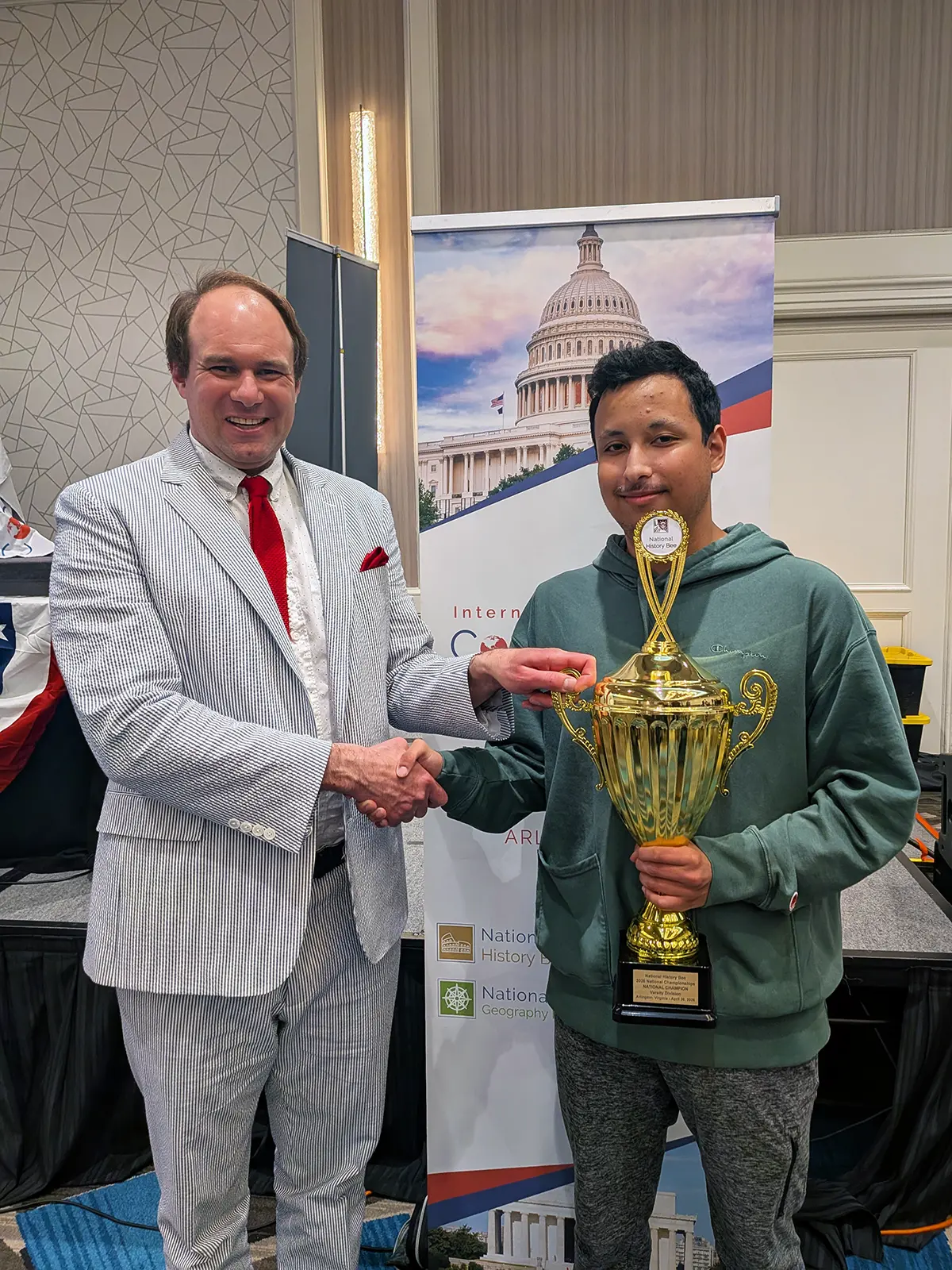
2026 National Champions
Varsity – Ayan Kancherla, Henry Gunn High School, Palo Alto, CA, 11th grade
Junior Varsity – Jaz Puri, Ransom Everglades School, Miami, FL, 10th Grade
The National History Bee Varsity & Junior Varsity Divisions Overview
The National History Bee is a quiz competition for individual students, testing knowledge of the history of all eras and all parts of the world. Founded as one of the first two IAC events in 2010, the National History Bee has welcomed hundreds of thousands of students since then in a competition celebrating knowledge of all facets of human history. The National History Bee consists of a network of Regional Tournaments, which are held both in-person and online from late October through early April. Qualified students then contest the annual National Championships each year on the last weekend of April in Arlington, VA. For 2027, the National Championships weekend will take place from April 22-25 with all National History Bee rounds taking place on Sunday, April 25. At Regionals and Nationals, the Junior Varsity Division is contested for students entirely in 10th grade and younger.
Jump To:
Competition Format
For students competing in the Varsity & Junior Varsity Divisions, the National History Bee is a two-stage competition, consisting of the Regional Tournaments, and the National Championships. Students can also qualify for the International History Olympiad by competing in the National History Bee.
1
Regional Tournaments
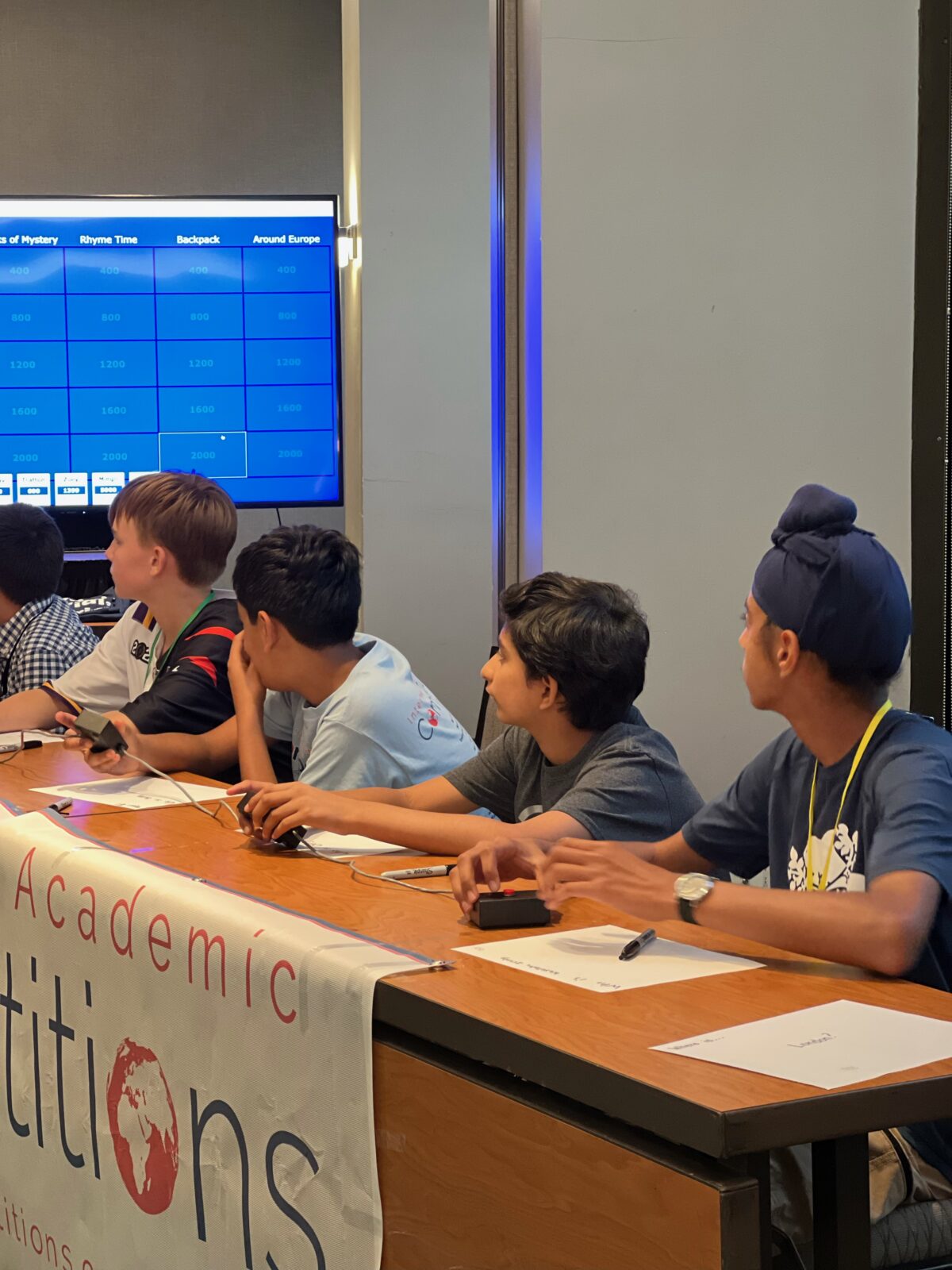
The first stage of the National History Bee in the Varsity and Junior Varsity Divisions are the Regional Tournaments, which includes our National Science, Geography and History Bee Regional Tournaments as well as our National History Bee and Bowl Regional Tournaments. Dozens of both types of these events are held each academic year, both in-person around the USA and online. At the Regional Tournaments, National History Bee competitions (at both Regional Tournament types) consist of 3 preliminary rounds and a final round. All National History Bee questions for the Varsity and Junior Varsity Divisions are played with a buzzer system. Students are read paragraph-length questions out loud with the clues arranged in decreasing order of difficulty. Students buzz in when they believe they know the answer; if they are correct, they score the point for that question, otherwise they cannot ring in again. Please see the rules files posted here for further details on how the competition works.
The Varsity and Junior Varsity Regional Tournament season runs from late October to early April each academic year. A list of tournaments is maintained on the website here; registration is done by clicking on the tournament you wish to attend and filling out the registration form on that tournament’s website.
National Science, History, and Geography Bee Regional Tournaments run on four separate question sets known as Red, White, Blue, and Gold. Thus together with the A, B, and C question sets played at the National History Bee and Bowl tournaments described below, students can thus play up to 7 times each year in the National History Bee: once on each question set. They only need to qualify for the National Championships at any one site; should students qualify at one site and then fail to reach a qualifying threshold at a subsequent site, their qualification for the National Championships remains intact.
Please note that all History Bee and History Bowl competitions are open to high school students, but only select regional Science, Geography, and History Bee tournaments are open to students in grades 9–12. Please check the appropriate column on the list of Science, Geography and History Bee tournaments before you register. Past questions can be found on the website here for practice.
Option A: National Science, Geography and History Bee Regional Tournaments
At our National Science, Geography and History Bee Regional Tournaments, the National History Bee will be offered along with the National Science Bee and the National Geography Bee. For these events that are available to high school students held prior to April 16 (the National Championships registration deadline for individual student events), there is a Varsity division for 12th and 11th graders, and a Junior Varsity Division which is limited to students in 10th grade and 9th grade. Students in 8th grade and younger are invited to participate in our age-appropriate divisions of our National Science, Geography and History Bee Regional Tournaments.
Online Regional Qualifying Exam
All students participating at our National Science, Geography and History regional tournaments must qualify through the Online Regional Qualifying Exams before they can compete. Students do not need to take the ORQE to participate at National History Bee and Bowl events, unless they are only participating in the National History Bee.
Prior to taking the ORQE, an adult sponsor (usually a parent or teacher) must first create a free sponsor account at this link. Once they have created an account, students can take the ORQE at any point. There is no cost to take the ORQE and there is no hard deadline for students to take it: the ORQE will remain available until the registration deadline for the last Regional Tournaments pass. However, we recommend that students take the ORQE as early as possible in the academic year so that they have more time to prepare for and compete at up to seven Regional Tournaments sites if they qualify.
Online Regional Qualifying Exam: Exam Structure
The ORQE is a 50 question multiple choice exam (4 answer choices per question) on all aspects of world history. Students have 20 minutes to take the exam, and the exam is scored automatically and immediately. In most cases, sponsors will see if the student qualified immediately in the Sponsor Dashboard, though early in the academic year, some students may receive a designation of “pending” if their score is close to where the qualifying cutoff score will be set. Once it is set, the pending designation will be removed and students will be listed as Qualified or Did Not Qualify in the Sponsor Dashboard.
There is no penalty for an incorrect answer, so students should answer each question as best as they can. The exam is designed so that on harder questions, students can often rule out 1 or 2 answer choices. About half of the questions have a visual component (i.e. a map, photograph, chart, etc.); for visually-impaired students who need to have the exam read out loud to them, these questions are not counted and their scores are prorated.
Online Regional Qualifying Exam: How to Prepare & Qualification Procedures
Students should use the ORQE versions from prior years to prepare (see Practice Resources), and perhaps review some basic knowledge of famous people and events in history. Nationwide, approximately 60% of students who take the ORQE will qualify for the Regionals. The qualifying scores vary from year to year and by age division, but typically students need to about half of the questions correctly in order to qualify. If students do not qualify on the ORQE, a second-chance ORQE is available beginning in the late fall so that they can try again.
For any questions on the Online Regional Qualifying Exam, please email help@iacompetitions.com.
Tournament Structure and Other Events
For our in-person National Science, Geography and History Bee Regional events, a sample of the schedule can be found here. For online NSGH Regional Tournaments, the Bees in two of the three subjects will be offered on Saturday, and the third subject will be on the Sunday; please check your specific tournament’s schedule for confirmation.
At our in-person NSGH Regional Tournaments, we will also be offering National Qualifying Exams over the course of the day, which can be used to qualify for other events at Nationals. For our online NSGH events, National Qualifying Exams will not be administered during the competition, but will be accepted as part of the tournament weekend’s results if taken before the tournament weekend ends. These exams are also available any time online here.
Nationals Qualification
Students qualify for the National Championships by finishing in the top 50% of their age division at any Regional Tournament. If a student qualifies for Nationals at one tournament, and then attends a second or third tournament and does not place in the top 50% at those, they are still qualified to compete at the National Championships.
Costs
The cost for the National History Bee regional tournaments (both in-person and online) is $54.
Option B: National History Bee and Bowl Regional Tournaments
Overall, History Bee and Bowl regional tournaments do not require prior qualification, and out-of-state students are always welcome at all tournaments, even those designated as a State Championship. The only exception to this is that students participating in the National History Bee and not the Bowl need to be qualified on the above-mentioned Online Regional Qualifying Exam.
Tournament Structure, Question Sets and Other Events
At our National History Bee and Bowl Regional Tournaments, the National History Bowl is offered instead of the National Science Bee and National Geography Bee. A sample schedule of an in-person National History Bee and Bowl Tournament is found here. Students in 8th grade and younger are allowed to participate in either our Junior Varsity division or Middle School division of the History Bee at these tournaments if they wish. National Qualifying Exams will also be offered during the lunch hour, which can qualify for other events at Nationals.
Each National History Bee and Bowl tournament runs on one of three question sets which are labeled A, B, and C. Chronologically, C Set is offered first, beginning in the fall, followed by B, and then A, which is first played in late January or February. However, C and B Set tournaments take place throughout the later months of the Regional Tournament season as well. B Set is very slightly harder than C Set, but the A Set is notably more difficult as it is meant as a tune up for the National Championships.
For each online National History Bee and Bowl event, the History Bee is typically on one day on a weekend, and the History Bowl on the other day. For our online History Bee and Bowl events, National Qualifying Exams will not be administered during the competition, but will be accepted as part of the tournament weekend’s results if taken before the tournament weekend ends. Those exams are also available any time online here. A sample schedule of an online National History Bee and Bowl Regional Tournament is found here.
Nationals Qualification
Students qualify for the National Championships by finishing in the top 50% of their age division at any Regional Tournament. If a student qualifies for Nationals at one tournament, and then attends a second or third tournament and does not place in the top 50% at those, they are still qualified to compete at the National Championships. Middle School students that are participating in the Junior Varsity division at a given NHBB tournament can only qualify for JV Nationals, while those in the Middle School division would only qualify for Middle School Nationals.
Costs
The cost for the National History Bee regional tournaments is $54, and for students participating at our in-person National History Bee and Bowl events, students receive a $24 discount if they are also participating in the History Bowl.
For all questions on the 2026-27 National History Bee Regional Tournaments, please email help@iacompetitions.com
2
National Championships
The second stage of the National History Bee for the Varsity and Junior Varsity Divisions is the National Championships, which for the 2026-27 academic year will take place at the Crystal Gateway Marriott in Arlington, VA on Sunday, April 25, 2027. We expect approximately 300 students to attend from throughout the USA, and we hope that you will be able to join us! All students play six preliminary matches on Sunday morning, with two playoff rounds taking place on Sunday afternoon.
Nationals Schedule and Other Events
On the same weekend that the National History Bee National Championships are held, there are numerous other competitions that take place at other times during that same weekend at the same hotel (e.g. the National History Bowl, National Geography Bee, US History Bee, National Championship Exams [a number of these have a history focus], National Science Bee, etc.), so students can take part in all of them if they are eligible to do so. A full schedule of 2027 Varsity & Junior Varsity National Championships Exams is available here.
Costs
The cost to compete in the National History Bee at the 2027 National Championships is $159. Registration for the National Championships opens in November and runs through early April on this page.
For all questions on the 2027 Varsity & Junior Varsity National Championships, please email help@iacompetitions.com.
Stage
International History Olympiad
Students who compete in the Varsity & Junior Varsity Divisions of the National History Bee can qualify for the 2027 International History Olympiad which will be held in the summer of 2027 in Berlin, Germany! Students qualify for the International History Olympiad by:
- finishing in the top third in their age division at any 2025-26 or 2026-27 National History Bee Regional Tournament.
- playing on a team that finishes in the top 25% in their age division at any 2025-26 or 2026-27 National History Bowl Regional Tournament.
- finishing in the top two thirds at the 2026 or 2027 National Championships of the National History Bee.
- playing on a team that finishes in the top 50% in their age division at the 2026 or 2027 National Championships of the National History Bowl.
- obtaining a passing score on the International History Olympiad Qualifying Exam.
There are other qualifying methods as explained here, but these approaches are the most typical ways to qualify. Note that high school seniors in the 2026-27 academic year are unfortunately unable to qualify as they will have aged out of eligibility by Summer 2027. However, successful students in the National History Bee are encouraged to apply for a position on the Olympiad staff.
The International History Olympiad is a week-long event with numerous competitions, field trips, family activities and more. In each event, medals are awarded to the top 3 competing students in each age division. US students compete for their state; students from other countries (or students in the USA who were born abroad or who have foreign citizenship) represent those countries. Two of the most prestigious events at the Olympiad are the International History Bee World Championships and the International History Bowl World Championships; an overall Olympiad Championship title is also awarded in each age division. Please view the website at www.historyolympiad.com for further details on all events and to register.
For all questions on the International History Olympiad, please email olympiad@iacompetitions.com.
National History Bee Practice Resources
Rules & FAQs
National History Bee Results
Past National Champions
On mobile, swipe right to view all columns
| Year | Division | National Champion | School | City | State |
|---|---|---|---|---|---|
| 2026 | Varsity | Ayan Kancherla | Henry Gunn High School | Palo Alto | CA  |
| 2026 | Junior Varsity | Jaz Puri | Ransom Everglades School | Miami | FL  |
| 2025 | Varsity | Robert Wang | Livingston High School | Livingston | NJ  |
| 2025 | Junior Varsity | Spencer Manning | Adlai Stevenson High School | Lincolnshire | IL  |
| 2024 | Varsity | Robert Wang | Livingston High School | Livingston | NJ |
| 2024 | Junior Varsity | Pranavkrishna Bharanidharan | Bella Vista High School | Fair Oaks | CA |
| 2023 | Varsity | Ian Lu | Hunter College High School | New York City | NY  |
| 2023 | Junior Varsity | Robert Wang | Livingston High School | Livingston | NJ |
| 2022 | Varsity | Andrew Zeng | Hunter College High School | New York City | NY |
| 2022 | Junior Varsity | Robert Wang | Livingston High School | Livingston | NJ |
| 2021 | Varsity | Andrew Zeng | Hunter College High School | New York City | NY |
| 2021 | Junior Varsity | Ian Lu | Hunter College High School | New York City | NY |
| 2020 | Varsity | Pedro Juan Orduz | Hunter College High School | New York City | NY |
| 2020 | Junior Varsity | Andrew Zeng | Hunter College High School | New York City | NY |
| 2019 | Varsity | Hari Parameswaran | Beavercreek High School | Beavercreek | OH  |
| 2019 | Junior Varsity | Shiva Oswal | Homeschool | Cupertino | CA |
| 2018 | Varsity | Alex Schmidt | Lehigh Valley Academy Regional Charter School | Bethlehem | PA  |
| 2018 | Junior Varsity | Govind Prabhakar | Adlai Stevenson High School | Lincolnshire | IL |
| 2017 | Varsity | Jakob Myers | Naperville North High School | Naperville | IL |
| 2017 | Junior Varsity | Justin Young | McLean High School | McLean | VA  |
| 2016 | Varsity | Jakob Myers | Naperville North High School | Naperville | IL |
| 2016 | Junior Varsity | Douglas Simons | High Technology High School | Lincroft | NJ |
| 2015 | Varsity | Bruce Lou | Saratoga High School | Saratoga | CA |
| 2015 | Junior Varsity | Alex Schmidt | Lehigh Valley Academy Regional Charter School | Bethlehem | PA |
| 2014 | Varsity | Jonathan Leidenheimer | George C. Marshall High School | Falls Church | VA |
| 2014 | Junior Varsity | Daniel Yan | Farragut High School | Knoxville | TN  |
| 2013 | Varsity | Sameer Rai | Bellarmine College Prep | San Jose | CA |
| 2013 | Junior Varsity | Connor Wood | Maggie Walker Governor’s School | Richmond | VA |
| 2012 | Varsity | Alex Frey | St. Joseph High School | Metuchen | NJ |
| 2012 | Junior Varsity | Sameer Rai | Bellarmine College Prep | San Jose | CA |
| 2011 | Varsity | Mark Arildsen | University School of Nashville | Nashville | TN |
| 2011 | Junior Varsity | Sameer Rai | Bellarmine College Prep | San Jose | CA |